Where the difficulty lies
Over 3 m the spot grows towards the detector edge, return light weakens and reading noise rises. Folding the path horizontally with a pentaprism lets the instrument sit on a stable table and shortens the path.
A pentaprism's 90° deviation is invariant with mounting angle, which is more reliable than a plain mirror, but its incidence-angle sensitivity and surface quality still leave 1–2″ to be declared as a systematic term.
How it was measured
The pentaprism rides a lift carriage, stopping every 300 mm to record X and Y angles. After each move, tap the carriage to release stick-slip and wait 5 s for a stable reading.
Read forward and reverse at each section and average, cancelling the pentaprism's small mounting tilt. Eleven sections, 22 readings, about 40 minutes.
Result and evaluation
Accumulating ten segments over 300 mm gives 37.4 μm from bottom to top. A least-squares line leaves a 0.4 μm peak-to-valley residual, so the column tilts uniformly rather than bending locally.
That is 12.5 μm/m against the 8 μm/m of GB/T 17421.1. Because the residual is so small, the fix is to shim the base as a whole, not to scrape locally.
Case workflow, animated
- Confirm the task and datum
- Lay out stations by span
- Acquire readings and convert
- Evaluate and verify
The animation follows the station layout and calculation order of this case. Values are teaching data.
Teaching data, used to show segmentation and conversion. Real acceptance follows the machine's own standard items, line count and tolerances; one generatrix does not conclude machine geometry.
Recommended instruments
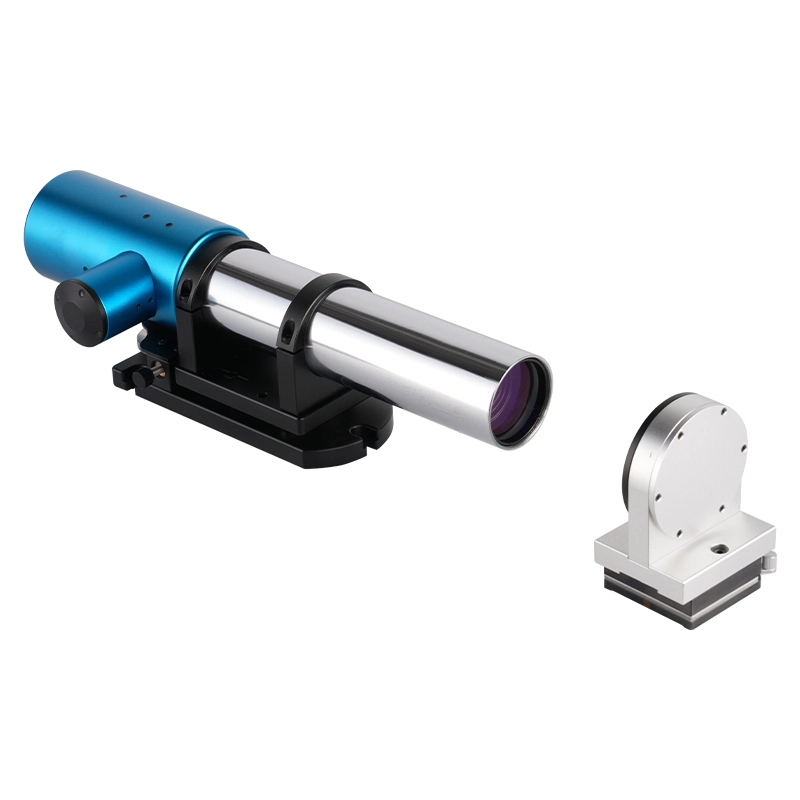
Dual-axis autocollimator, accuracy 0.1″, range 30 m
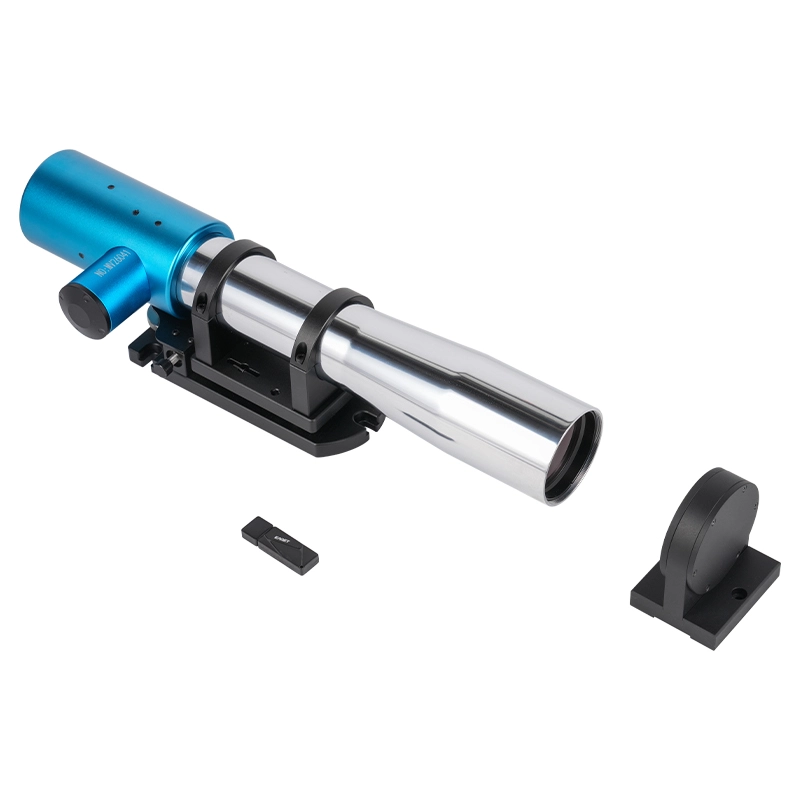
Dual-axis autocollimator, accuracy 1″, range 40 m